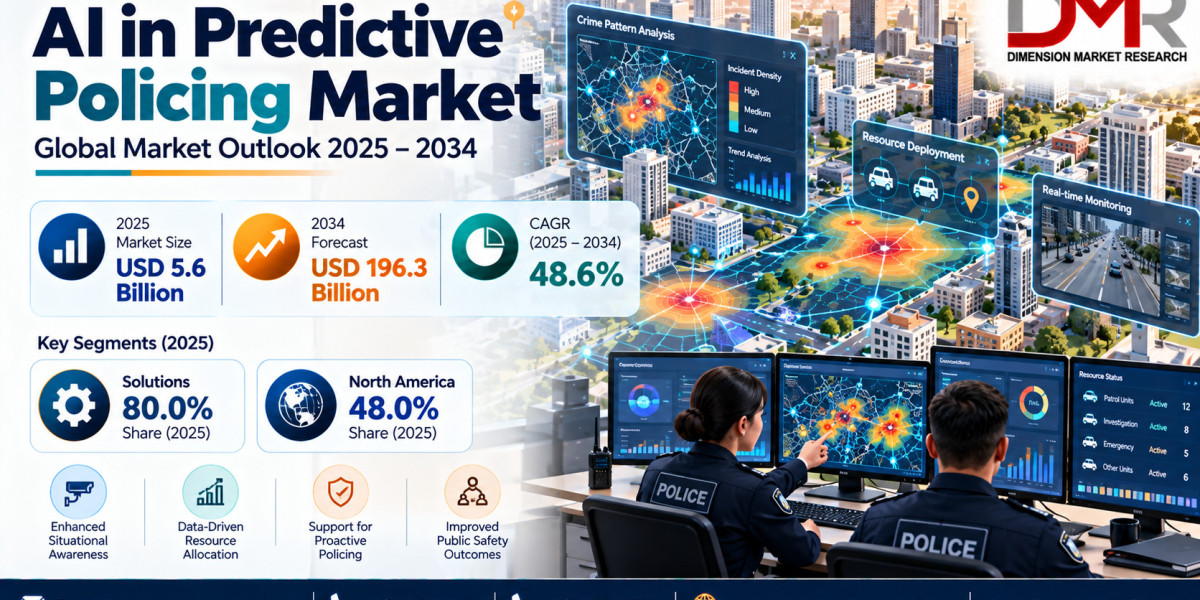
The global AI in Predictive Policing Market is attracting attention as law enforcement agencies explore artificial intelligence, machine learning, and predictive analytics to support resource planning, crime-pattern analysis, and investigative operations. According to Dimension Market Research, the market is projected to reach USD 5.6 billion in 2025 and USD 196.3 billion by 2034, expanding at a reported CAGR of 48.6%.
Increasing availability of digital information, advancements in analytical software, and investment in public safety technology are influencing this emerging industry. Predictive policing platforms analyze historical records and other permitted datasets to identify patterns that may inform operational planning.
However, these technologies also raise significant questions about algorithmic bias, civil liberties, surveillance, and accountability. Their commercial expansion does not necessarily establish that they reduce crime or improve public safety outcomes.
What Is the AI in Predictive Policing Market?
The AI in Predictive Policing Market covers software platforms and related services designed to analyze data relevant to law enforcement activities.
These technologies may use machine learning, natural language processing, computer vision, and statistical modeling to examine historical patterns and support operational decisions.
Potential applications include geographical crime-pattern analysis, patrol resource planning, investigation support, and information management.
Predictive outputs are probabilistic rather than certain. They should not be interpreted as proof that an individual will commit an offense.
AI in Predictive Policing Market Size and Key Statistics
The DMR report provides the following estimates for 2025:
● 2025 Market Size: USD 5.6 Billion
● 2034 Market Forecast: USD 196.3 Billion
● Forecast CAGR: 48.6%
● North America Market Share: 48.0%
● Solutions Market Share: 80.0%
● On-Premises Deployment Share: 70.0%
● Large Enterprise Share: 60.4%
● Natural Language Processing Share: 40.2%
● BFSI End-User Share: 38.8%
● US Market Size: USD 2.3 Billion
The inclusion of BFSI and broader commercial applications in the source segmentation means these estimates should be interpreted within the report's defined scope rather than exclusively as policing technology expenditure.
Why Is the AI in Predictive Policing Market Growing?
Investment in Public Safety Data Infrastructure
Government agencies and law enforcement organizations are investing in systems that help manage large volumes of operational information.
Analytical tools may assist agencies in reviewing historical incident patterns, planning staff deployment, and identifying changes in reported activity.
Interest in integrated information systems and automated reporting is contributing to market development.
However, performance must be evaluated against independently defined outcomes, rather than assuming that more sophisticated predictions automatically result in greater public safety.
Advancements in Artificial Intelligence and Data Analytics
Machine learning technologies can analyze patterns across large datasets that may be difficult to review manually.
Natural language processing supports the organization of unstructured records, while computer vision enables selected forms of image and video analysis.
The growing availability of computing infrastructure and specialized software is expanding the technical capabilities available to public sector organizations.
These developments create opportunities for analytics providers, system integrators, and cybersecurity specialists.
Get a Free Sample of the AI in Predictive Policing Market Report
Explore market forecasts, deployment models, technology segmentation, competitive intelligence, regional analysis, and industry opportunities through the Dimension Market Research study.
https://dimensionmarketresearch.com/request-sample/ai-in-predictive-policing-market/
How AI and Predictive Analytics Are Influencing Policing Technology
AI systems are being developed to support information processing, analytical workflows, and selected operational planning activities.
Natural language processing can assist with classifying written records and extracting relevant information from large collections of documents.
Machine learning may identify historical geographical or temporal patterns in recorded incidents.
Important technology developments include:
● AI-assisted incident pattern analysis
● Automated investigative document processing
● Secure analytical data management
● Explainable model evaluation systems
Explainability and auditability are particularly important in law enforcement because automated outputs can affect individuals and communities.
Historical police records may contain reporting differences and enforcement biases. Models trained on such information risk reproducing those patterns.
Consequently, independent validation, legal authorization, human oversight, and clear limits on data use are central considerations.
AI in Predictive Policing Market Segmentation Analysis
Solutions Lead the Offering Segment
Solutions account for approximately 80.0% of market revenue in 2025.
The segment includes analytical software and platforms used to process information and support operational workflows.
Services cover consulting, implementation, maintenance, training, and system integration.
Demand for professional services may increase as organizations evaluate governance requirements and integrate analytical tools with existing infrastructure.
On-Premises Deployment Maintains Leadership
On-premises systems represent approximately 70.0% of the market in 2025.
Their leadership reflects organizations' preference for maintaining control over sensitive records and internal technology infrastructure.
Cloud platforms may offer scalability and collaborative capabilities, although handling sensitive information requires stringent security, access controls, and compliance assessments.
Large Enterprises Dominate Organization Size
Large enterprises account for approximately 60.4% of revenue in 2025.
These organizations are more likely to possess the technical infrastructure and financial resources required for complex analytics deployments.
Smaller organizations may consider managed services or modular solutions to reduce initial infrastructure costs.
Natural Language Processing Leads Technologies
Natural language processing accounts for 40.2% of market revenue in 2025.
Its applications include document categorization, text analysis, information extraction, and analytical reporting.
Computer vision, machine learning, and deep learning are additional technology categories.
Deployments involving personal data, surveillance, or individual risk assessments require particular scrutiny.
BFSI Leads the Report's End-User Segmentation
The DMR report identifies BFSI as the largest end-user category, with 38.8% share in 2025.
This category primarily includes applications such as financial fraud detection and risk analysis.
Because such activities are distinct from law enforcement predictive policing, this segment reinforces the need to interpret the published market definition carefully.
Government and defense are separately included in the source segmentation.
Regional Outlook: North America Leads the Market
North America is projected to account for approximately 48.0% of market revenue in 2025.
The region benefits from an established AI technology ecosystem, government technology procurement, and analytics software development.
The United States market is estimated at USD 2.3 billion in 2025, with the DMR report forecasting growth to USD 65.9 billion by 2034.
Europe represents an important market for public sector technology, although adoption is shaped by privacy legislation, fundamental rights protections, and restrictions on certain AI applications.
Asia-Pacific is identified by DMR as a region with significant growth potential, supported by smart city initiatives, digital infrastructure development, and public sector technology investment.
Country-specific legal requirements and institutional safeguards will influence the practical addressable market.
Competitive Landscape and Leading Companies
The market includes enterprise software companies, specialized analytics providers, and public safety technology vendors.
Companies identified in the DMR report include Palantir Technologies, Microsoft, IBM, Axon, SoundThinking, Veritone, IDEMIA, SITA, Cimphony, and Geolitica, the latter associated with the former PredPol brand.
These companies have different technology portfolios, and inclusion in the competitive landscape does not mean every company currently offers an equivalent predictive policing product.
Competition involves data integration, analytical capabilities, cybersecurity, system reliability, explainability, and compliance.
Vendor assessments increasingly need to consider evidence of practical effectiveness alongside technical features.
Market Challenges and Future Growth Opportunities
Algorithmic bias, historical data limitations, inadequate transparency, and privacy concerns remain substantial challenges.
A predictive model may identify correlations within historical incident records without establishing causal relationships or reliably predicting future criminal behavior.
Feedback loops can also arise when increased policing generates additional recorded incidents in areas already subject to greater enforcement.
Commercial opportunities exist in privacy-preserving analytics, secure information management, independent model auditing, and accountable decision-support systems.
Organizations able to demonstrate lawful use, transparent evaluation, and meaningful safeguards may be better positioned to address institutional requirements.
Explore the Complete AI in Predictive Policing Market Analysis
Access detailed market estimates, deployment segmentation, regional opportunities, technology trends, and competitive profiles through the Dimension Market Research report.
https://dimensionmarketresearch.com/checkout/ai-in-predictive-policing-market/
Frequently Asked Questions
1. What is the AI in Predictive Policing Market size?
Dimension Market Research estimates the market at USD 5.6 billion in 2025 and forecasts USD 196.3 billion by 2034.
2. What is the CAGR of the AI in Predictive Policing Market?
The report provides a forecast CAGR of 48.6% for 2025 to 2034.
3. Which offering segment leads the market?
Solutions lead with approximately 80.0% market share in 2025.
4. Which region dominates the market?
North America leads with approximately 48.0% revenue share in 2025.
5. What are the major opportunities and risks?
Opportunities include analytical software, secure information management, explainable AI, and model auditing. Major risks include bias, privacy violations, insufficient transparency, and unreliable predictions.
Conclusion
The AI in Predictive Policing Market reflects growing interest in the intersection of artificial intelligence, analytical software, and public sector information systems.
Solutions, on-premises deployment, and natural language processing are important segments within DMR's published market framework.
However, predictive policing remains a sensitive application requiring careful scrutiny of actual effectiveness, legal permissibility, and impacts on individual rights.
Long-term market development will depend not only on technological progress but also on transparent procurement, independent testing, proportionate data use, and effective accountability.
Related Predictive Analytics and Decision Intelligence Market Insights
The Predictive Analytics Market Size is projected to increase from USD 22.3 billion in 2025 to USD 147.3 billion by 2034, at a reported CAGR of 22.3%. Applications span financial risk management, retail demand forecasting, healthcare planning, supply chain optimization, and other business functions. North America accounts for approximately 38.9% of revenue in 2025.
The US Predictive Analytics Market Share analysis forecasts growth from USD 7.6 billion in 2025 to USD 45.2 billion by 2034, at a CAGR of 21.8%. Cloud-based solutions lead deployment demand as organizations invest in real-time forecasting, fraud analytics, business intelligence, and operational planning.
The Predictive and Prescriptive Analytics Market Growth study projects expansion from USD 14.3 billion in 2026 to USD 141.4 billion by 2035, registering a CAGR of 29.0%. North America is expected to account for approximately 39.2% of market revenue in 2026. AI-driven forecasting, scenario modeling, automated decision support, and cloud-based platforms support demand across enterprise applications.