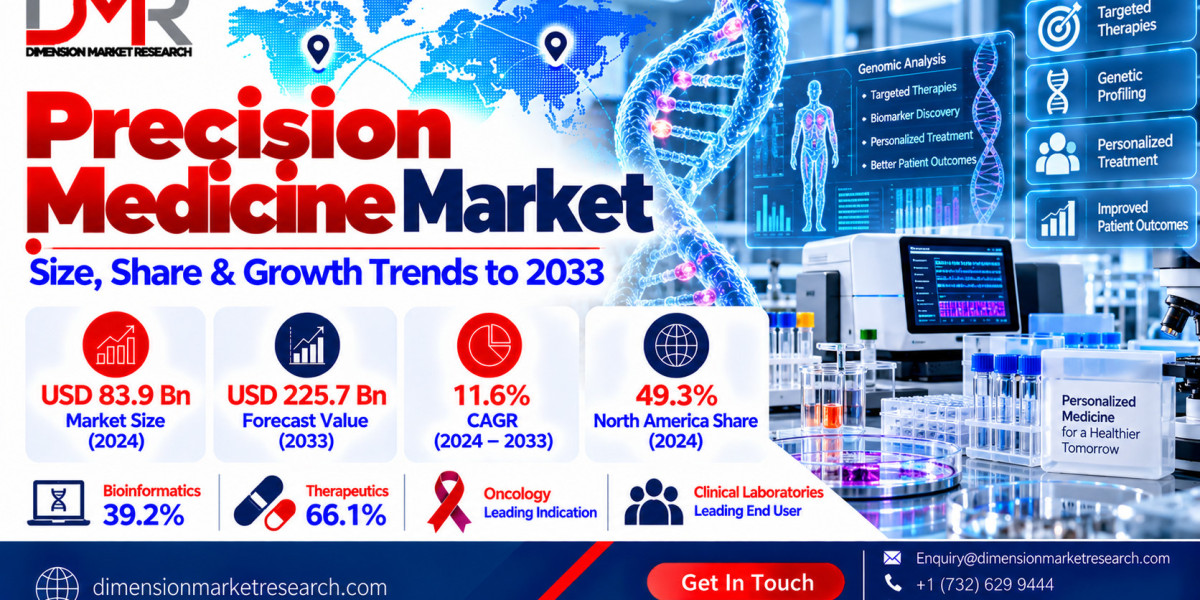
According to Dimension Market Research, the Precision Medicine Market was estimated at USD 83.9 billion in 2024 and is projected to reach USD 225.7 billion by 2033, registering an 11.6% CAGR. These figures reflect the report’s July 2024 edition.
The research identifies genomic sequencing, data analytics, and investment in individualized healthcare as growth themes. For pharmaceutical companies, diagnostic developers, laboratories, and investors, the commercial question is how these capabilities connect with a specific application and a credible implementation plan.
What Is the Precision Medicine Market?
Precision medicine considers genetic, environmental, and lifestyle information when developing individualized approaches to care.
For market analysis, this creates several distinct areas to evaluate. A diagnostic platform, an analytical service, and a therapeutic product serve different customers and perform different roles. Their opportunities should therefore be assessed against their intended use.
A useful starting point is to define the proposed offering precisely. Identify the user, the information or capability provided, and the decision it is intended to support. This gives a commercial assessment a clearer foundation.
Bioinformatics and Therapeutics Lead Important Segments
DMR projects bioinformatics to account for 39.2% of technology revenue in 2024. Therapeutics leads applications with 66.1%, while oncology leads indications.
The analytical implication is to examine technology and application together. A platform’s capabilities should be evaluated in relation to the task it is expected to perform.
For a prospective buyer, a useful comparison begins with the same requirements for every provider. Ask what information the offering uses, what output it produces, and which responsibilities remain with the customer.
For developers, those questions can guide positioning. A specific explanation of where an offering fits provides more commercial clarity than a broad claim about personalization.
Get a Free Sample of the Precision Medicine Market Report
Review the sample to explore the report’s index, taxonomy, methodology, segmentation, and company-profile coverage. These materials can help you assess whether the complete study addresses your questions about technologies, applications, end users, and competitive positioning.
https://dimensionmarketresearch.com/request-sample/precision-medicine-market/
Laboratory Demand Deserves an Offering-Level Assessment
Clinical laboratories are identified as the leading end-user category.
For suppliers considering this customer group, market leadership should prompt closer investigation of operating requirements. Which part of the laboratory workflow does the proposed product address? What supporting documentation will the buyer require? How will the offering be introduced into existing processes?
These questions help distinguish an attractive customer segment from a specific, serviceable opportunity.
They also make partnership discussions more useful. Each participant should be able to explain its contribution, the responsibilities it accepts, and the evidence needed before moving forward.
North America Leads the Regional Outlook
North America holds a projected 49.3% revenue share in 2024. DMR associates its position with healthcare infrastructure, research investment, and technology adoption.
For regional expansion, the next step is to connect that outlook with a defined customer and route to market. An established market requires a clear explanation of differentiation and the resources needed to support customers.
A practical entry assessment should identify the intended institutions, relevant partners, and implementation requirements. It should also make outstanding questions visible.
This approach helps strategy teams assess execution readiness alongside market attractiveness, rather than treating regional size as a complete business case.
Cost and Access Shape Commercial Planning
The report identifies high costs and approval and reimbursement complexity as constraints.
The business implication is to examine the complete implementation proposal. Decision-makers should document assumptions, establish responsibilities, and identify which questions require further investigation.
An investment assessment can distinguish demonstrated capabilities from development objectives. A procurement assessment can clarify what the supplier provides and what the buyer must contribute.
This creates a consistent basis for comparing alternatives. It also helps teams avoid building a commercial plan around assumptions that have not yet been tested.
Competitive Landscape: Compare Roles Across the Value Chain
Report-listed participants include Pfizer, Novartis, QIAGEN, Quest Diagnostics, Roche, and Eagle Genomics.
Competitive benchmarking should begin by identifying which offerings are directly comparable. Assessing a diagnostic specialist against a therapeutic developer requires a different framework from comparing two analytical platforms.
Within each category, ask providers to address the same use case. Examine the proposed capabilities, supporting information, implementation arrangements, and customer assistance.
The objective is a clear account of where each business competes and what differentiates its offering.
Future Outlook: Connect Innovation With a Defined Use Case
A practical interpretation of the forecast is to treat growth as a reason for focused investigation. Businesses should identify the application they intend to serve and the evidence needed to support their proposition.
For developers, this can guide product priorities. For investors, it provides a framework for assessing commercial readiness. For partners, it clarifies which capabilities need to be combined.
Market intelligence becomes more useful when it leads to specific decisions about customers, development, and implementation.
Explore the Complete Precision Medicine Market Analysis
Explore the complete report to assess its segmentation, regional coverage, and competitive profiles against your planning requirements. Proceed to the verified checkout page to review available license options.
https://dimensionmarketresearch.com/checkout/precision-medicine-market/
FAQs
1. What is the market size?
DMR estimates USD 83.9 billion in 2024.
2. What is the forecast CAGR?
The reported CAGR is 11.6% for 2024 to 2033.
3. Which technology leads?
Bioinformatics leads, with 39.2% projected revenue share in 2024.
4. Which region leads?
North America leads, with 49.3% projected share in 2024.
5. What is the forecast value?
The market is projected to reach USD 225.7 billion by 2033.
Conclusion
The forecast provides a foundation for assessing individualized healthcare opportunities. Its commercial relevance comes from connecting technology with a defined application, credible evidence, and an achievable implementation plan. Focused evaluation can help businesses identify where their capabilities fit best.
Related Personalized Healthcare Market Insights
The Personalized Medicine Biomarker Market Size is projected to increase from USD 17.0 billion in 2024 to USD 72.7 billion by 2033 at a 17.5% CAGR. The study examines biomarker identification, validation, and application, providing complementary context for diagnostics and individualized healthcare research.
The Precision Neurology Market Share analysis identifies genomics as the leading technology, with 38.6% revenue share in 2026. DMR estimates the overall market at USD 22.47 billion in 2026, reaching USD 96.19 billion by 2035 at a 16.4% CAGR.
The Pharmacogenomics Market Growth outlook projects USD 6.9 billion in 2024 and USD 12.0 billion by 2033 at a 6.3% CAGR. Its coverage of genetic variation and medication response offers a related perspective on technologies supporting individualized drug-development and treatment research.